


This follows our latest report highlighting ten key customer service stats that reveal why human customer service continues to outperform AI. You can also see how speed and genuine human connection drive real results in our call answering secrets guide.
–
For years, businesses have been sold the same promise: AI will transform customer service. Faster replies. Lower costs. Infinite scale.
But the newest global data tells a very different story, one every business leader should pay attention to.
Trust in AI has not just stalled. In many sectors, it is in active decline. People are growing more cautious and skeptical, and in high-stakes situations they are refusing to rely on automated systems altogether.
Companies pursuing an AI-first approach are now discovering the real cost of replacing people with automation: lost trust, lost loyalty, and lost customers.
People still prefer real people, by a huge margin
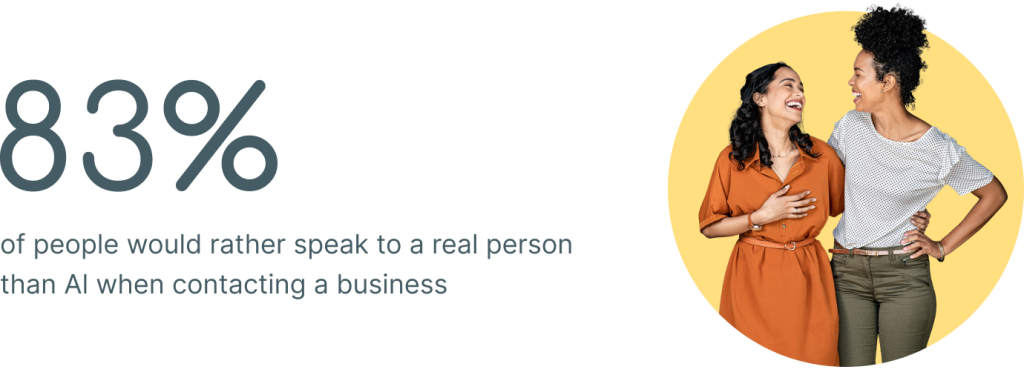
When contacting a business, 83% of people would rather speak to a real person than AI.
That preference becomes even stronger in high-stakes moments: 89% prefer a real person when contacting their healthcare providers, 87% when contacting a law firm, and 85% when dealing with local service providers like plumbers and electricians.
In these situations, accuracy, reassurance, and empathy are paramount. Customers overwhelmingly believe that only humans can provide these qualities.
This is why businesses that prioritize human connection are poised to succeed.
One in three callers hang up the moment they hear AI
This might be the most urgent finding of all.
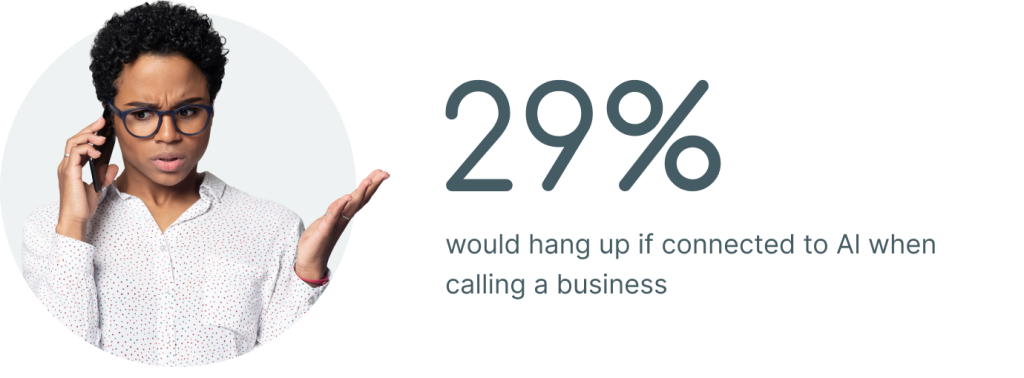
When people call a business and are connected to AI, 29% hang up immediately.
That’s almost one in three people lost before the conversation even begins.
This is not a minor inconvenience for callers. It is a direct revenue leak for businesses. Every caller who hangs up represents a lost lead, a missed booking, or a conversation that never even gets the chance to build trust.
Trust breaks down fast when AI handles critical information
People do not trust AI when real consequences are involved. Consumers may tolerate AI for simple tasks, but when accuracy, judgment, and reassurance are needed, they want a human in control.
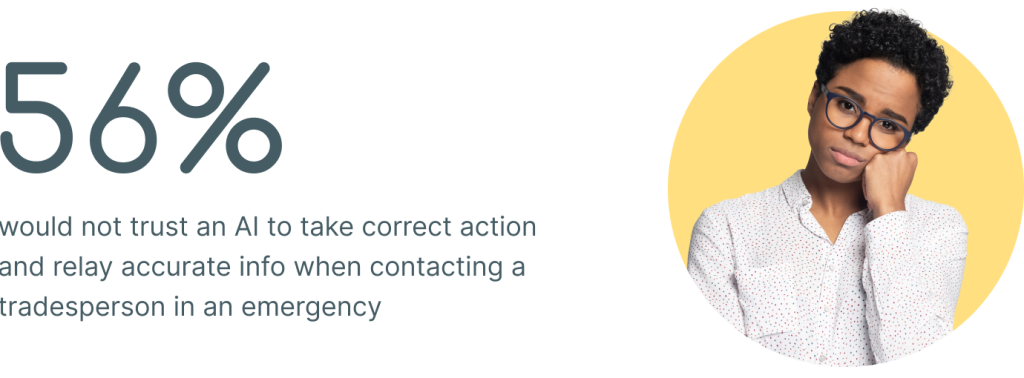
In emergencies, 56% of people do not trust AI to handle a tradesperson call, 54% are wary of AI managing law firm interactions, and 47% do not trust AI to manage medical appointments.
This is not mild scepticism. Half the population openly says AI cannot be relied on to take the right action or provide accurate information when it matters most.
People are not being dramatic. They are being realistic. A misunderstood sentence or a wrong decision can have real consequences, and customers are not willing to take that risk.
If you want to see how AI mistakes have damaged brands in the real world, explore our breakdown of seven high-profile AI fails and what they cost businesses.
People do not trust AI-led companies
When a business relies heavily on AI for customer service, it damages brand trust.
More than half (53%) of people say they trust a business less if it relies mostly on AI for customer service, while only 13% report that it increases their trust.
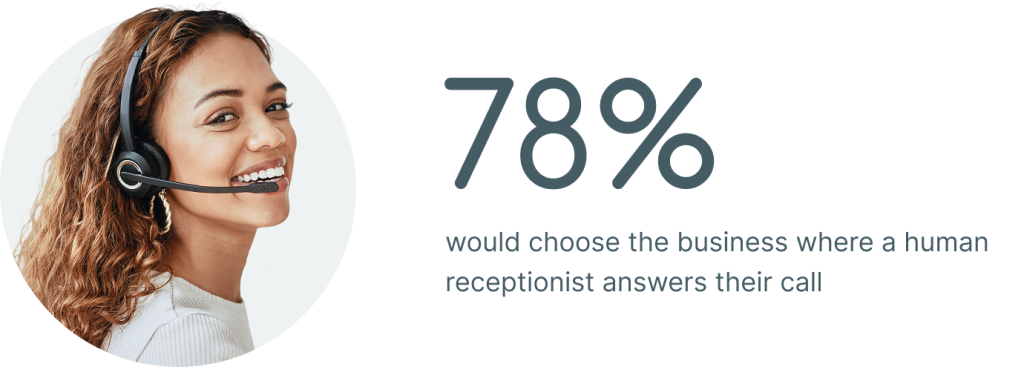
Consumer choice is directly affected: 78% would choose a business where a human receptionist answers the call, compared with just 9% opting for an AI-led service.
Trust also drives loyalty: 69% would be more loyal to a company that uses humans rather than AI for service interactions.
Businesses that lean too heavily on automation risk driving customers away instead.
Concerns about AI are growing beyond customer service
The trust issue runs deeper than bad chatbot interactions. Consumers are becoming wary of AI at a societal level.
Globally, 78% of people are concerned that AI will replace human jobs in the next five to ten years, and 75% worry specifically about AI replacing roles in customer service.
More than half (52%) believe AI companies should be held accountable if AI fails to act when someone expresses suicidal intent, and 59% say artists should be compensated if AI mimics their style.
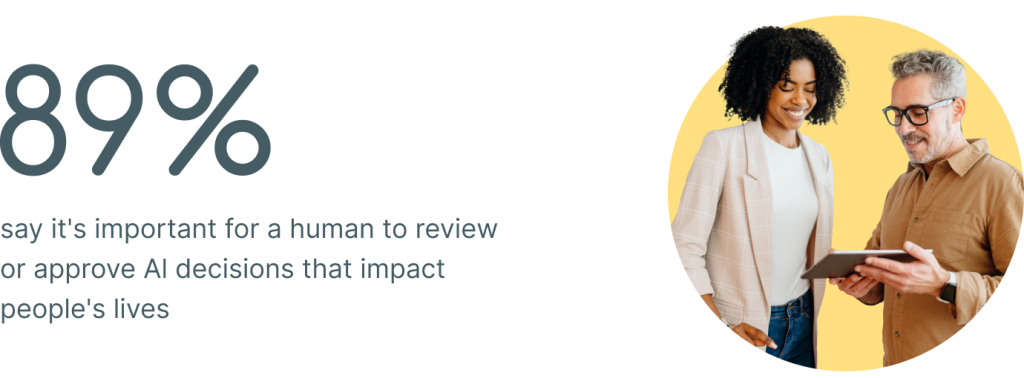
Most strikingly, 89% of people say it is important for a human to review or approve AI decisions that impact people’s lives.
Consumers want oversight, accountability, and humans in the loop. AI alone is not enough. People want humans in control.
Human connection still defines great service
When asked what matters most in a service interaction, customers prioritize traits that depend on human judgment. 73% want their issue resolved, 63% value knowledgeable responses, 49% appreciate friendliness, and 34% value personalization.
These are human strengths. They depend on context, nuance, and empathy – qualities only humans can consistently provide.
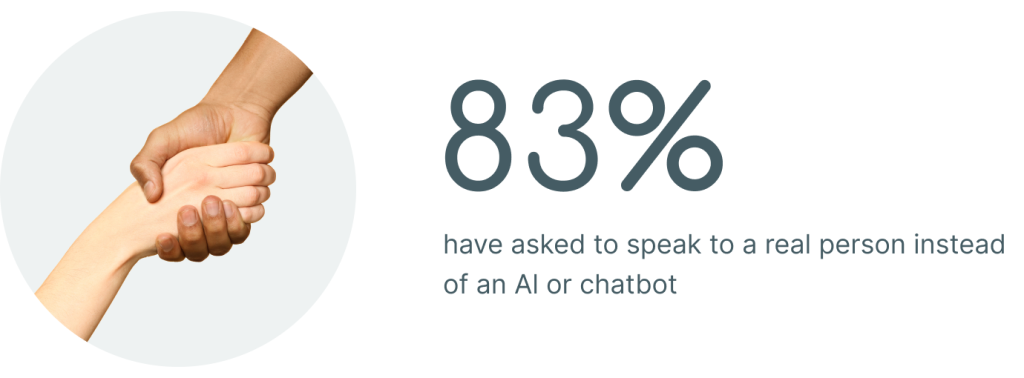
And customers know it. That is why 83% have asked to speak to a real person when dealing with an AI agent or chatbot. They trust real people, and know when AI hits its limits.
To see how we put people first in our own service approach, discover why we pledge real people over bots.
The stakes for businesses have never been higher
If companies continue replacing people with AI, customers believe service will get worse.
The message from the data is clear: AI cannot deliver trust. Only people can.
Automation has its place. But when it replaces human connection, accuracy, or empathy, it does not streamline service. AI erodes confidence. AI pushes customers away. AI damages brands.
Businesses that prioritize human-first service will be the ones that win trust, credibility, and loyalty in an AI-saturated world.
Companies using AnswerConnect keep real people on the front line of their customer service. Instead of routing callers through impersonal automation, every conversation is handled by trained human receptionists who listen, understand context, and act with care.
This approach protects trust, prevents lost leads, and ensures customers feel valued, even in high-pressure or time-sensitive situations.
Ready to deliver service customers actually trust?
Speak with a real person today.
Call 800-700-8888 or book a consultation to see how human-led customer service can transform your business.

AnswerConnect OnePoll survey of 6,000 adults – October 2025
Quick takeaways
- Customers overwhelmingly prefer humans over AI, especially in high-stakes situations where trust matters most.
- One in three callers hang up as soon as they hear AI, cutting conversations and revenue short before trust can even form.
- Heavy reliance on AI actively reduces brand trust and weakens customer loyalty.
- Concerns about AI extend beyond customer service into jobs, accountability, and human oversight.
- Human connection remains the strongest driver of confidence, satisfaction, and long-term trust.
- Businesses that keep people involved in customer interactions consistently outperform those that automate without restraint.